
Hillingdon raised petition thresholds on 9 July: 50 signatures for a street issue, 500 borough-wide. Of seven petitions open this month, three cleared the bar.
Getting Hillingdon Council to formally consider a petition about your street now takes 50 signatures rather than 20, and a petition about council policy across the borough needs 500 rather than 100. The change was approved at Full Council on 9 July and applies to every petition started since.
The numbers come from the council’s own report to that meeting, which proposed “an increase from 20 to 50 signatures for local and planning petitions to be confirmed as valid and from 100 to 500 for valid Borough-wide petitions”. The stated reasoning is that digital petitioning has made signatures easier to gather: the report says the change “reflects the fact that petitions are now easier to create, circulate and support” and that it leaves Hillingdon “relatively accessible compared with many other boroughs”. (Report of the Head of Democratic Services, Council, 9 July 2026)
The same report removed something else residents had: the automatic petition hearing. Under the old arrangement a qualifying petition triggered a hearing in front of the relevant Cabinet Member. That is now replaced by “either a written response or a site visit”, with the lead petitioner promised a written response within 20 working days and a site visit, where one is agreed, within eight weeks.
Three of seven have cleared the bar
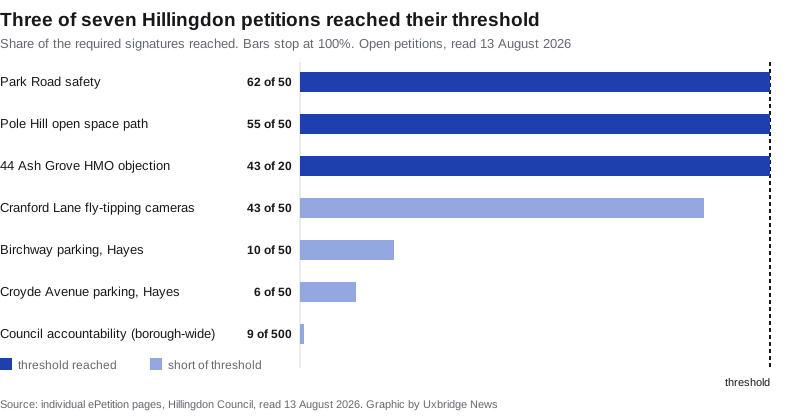
Seven ePetitions were open on the council’s site this month. Three had passed their threshold and four had not.
| Petition | Signatures | Needs | Closes |
|---|---|---|---|
| Road safety on Park Road (B483), Swakeleys Roundabout to Gatting Way | 62 | 50 | 16 Aug |
| Pole Hill open space walking and jogging path | 55 | 50 | 13 Aug |
| Objection to a six-bedroom HMO at 44 Ash Grove, Harefield | 43 | 20 | 13 Aug |
| Cameras to detect fly-tipping on Cranford Lane | 43 | 50 | 3 Sep |
| Residential parking on Birchway, Hayes | 10 | 50 | 12 Sep |
| Council accountability and transparency | 9 | 500 | 13 Aug |
| Resident parking on Croyde Avenue, Hayes | 6 | 50 | 12 Sep |
(Current ePetitions, Hillingdon Council)
The one propped at the bottom of that chart is the petition objecting to the change itself. It asks the council to put a consultation system in place before it makes any change to its constitution that reduces transparency or accountability, or makes it harder for residents to raise concerns with councillors, and it lists the higher signature thresholds first among its complaints. Because it concerns council policy across the borough, it is held to the new 500 mark. It was due to close on 13 August with 9 names on it.
The council was aware of that objection when it voted. The minutes record that those speaking for the change “advised that a petition had been received in opposition to the proposed changes to Hillingdon’s petition scheme and that this had been taken into account before moving the recommendations”, and argued the new scheme would “improve consistency, reduce bureaucracy and speed up the process whilst also bringing the petition scheme in line with neighbouring boroughs”. Those against said it amounted to “a significant reduction in residents’ rights” and that scrapping petition hearings removed “an opportunity for residents to hold Cabinet Members to account”. (Draft minutes, Council, 9 July 2026)
The item was taken with three other democratic services matters in a single recorded vote, carried by 34 votes to 16 with no abstentions.
Planning petitions are the exception, for now
One threshold has not moved yet. Planning petitions still qualify at 20 signatures, which is why the Harefield HMO objection cleared its bar at 43 while the Cranford Lane fly-tipping petition, on the same 43, is still seven short of its 50.
The council’s report sets out why: the planning changes are tied to national reforms to planning delegation and “come into effect at the same time as the new planning legislation, which will take effect 31 October 2026”, with a further report due to Council in September. Petitions submitted before that date keep the 20-signature threshold; those after will need 50.
The bigger change for planning is not the number. Under the new framework, the report says, “speaking rights will only apply where an application is already being determined by Planning Committee. Where applications are decided by planning officers, petitions will still be considered as part of the decision-making process, but there will be no right to speak.” At present a petition can in some cases influence whether an application goes to committee at all. The council recorded that it had objected to the legislation driving this, but that it is required to make the change.
What it means for you
If you are thinking of starting a petition, three things now decide whether it lands.
The first is which tier you are in. A problem confined to one street or neighbourhood is a local petition and needs 50. Anything about council policy or services across Hillingdon is borough-wide and needs 500, a bar that the two Hayes parking petitions would never have to clear but that stopped the accountability petition dead.
The second is who signs. Anyone can add their name, but the council counts only “valid signatures from Hillingdon residents” towards the threshold. A petition shared widely online can look healthy and still fall short.
The third is the clock. ePetitions are reviewed within five working days before going live and then run for a maximum of one month, or less if a decision on the matter is expected sooner. Fifty valid names inside four weeks is the real test, and on the current evidence it is not a formality: the Croyde Avenue petition against Heathrow holiday parking had six signatures a day into its run, and Birchway had ten.
Paper and online petitions can be combined to reach the total, but only where they come from the same lead petitioner and use exactly the same wording on exactly the same matter.
Two routes are untouched by all of this. Licensing petitions are still handled as formal representations under licensing law, and referendum petitions still fall under their own statutory rules.
If your petition is about a planning application, our Uxbridge planning news page covers how applications are decided locally, and Uxbridge roadworks and travel tracks the street-level changes that tend to prompt petitions in the first place.
Have your say