
Auditors still cannot give full assurance on Hillingdon Council's 2025/26 accounts and report three significant weaknesses. Councillors see the papers on 25 November.
Hillingdon Council’s auditors still cannot give full assurance on its accounts, and the council does not expect them to before its 2029/30 accounts at the earliest.
The position is set out in a report for the council’s Audit, Finance and Performance Committee, which meets on Wednesday 25 November. It covers the 2025/26 accounts, audited by Ernst & Young (EY) (External Accounts Update).
Overview
- EY has not been able to complete all its planned audit work on 2025/26, so it does not have reasonable assurance over all of the year’s movements and closing balances.
- The 2023/24 and 2024/25 accounts both received a “disclaimer opinion”, meaning the auditors could not give an opinion at all.
- Full assurance is not expected until the 2029/30 accounts “at the very earliest”.
- EY’s draft report finds three significant weaknesses in the council’s arrangements: financial sustainability, the quality of council information and the capacity of the finance team.
- The council’s pension fund accounts are a different story: they have had clean audit opinions.
Why the audit is still incomplete
The council published its draft 2025/26 accounts on 6 August. That was a month earlier than the year before, but still a month after the statutory deadline of 30 June.
The report says the 2023/24 and 2024/25 disclaimers mean some of the balances brought forward into 2025/26 are not fully assured. Under government guidance, councils in that position rebuild assurance step by step, year by year.
The audit is due to finish by the end of November. Officers expect to sign off the final accounts before mid-December, ahead of the national backstop date of 31 January 2027.
Of the areas of the audit still rated red, the report lists:
- 7 where the auditors could not complete their work, in areas such as pay and journals
- 2 on additions and disposals of property, plant and equipment
- 2 on specialist debtors
- 2 on specialist creditors
- 1 each on reserves, the council as a “going concern” and disclosure requirements
The report says the improvement on the year before has been “less pronounced” than in the previous year.
EY rated eight measures of how the accounts were prepared. Two were “ineffective”: the lateness of the accounts and the number of misstatements in the disclosure notes. Four were rated “requires improvement” and two “effective”.
Corrections made during the audit
The revised accounts in the papers carry a long list of changes made after EY’s feedback. Most are presentation. Some are figures, including:
- a £21m public health grant, previously counted under “other” grants, now shown on its own
- spending financed from capital but not creating council assets, corrected from £5.231m to £8.873m
- business rates: the total rateable value in the borough corrected from £835.0m to £849.478m, and the number of rated properties from 8,934 to 8,954
The report says the remaining changes “principally relate to finalisation and refinement of supporting disclosures rather than changes to the Council’s reported financial position”. Changes to property values are still waiting on the audit.
The statutory recommendations
In August 2025, EY made seven statutory recommendations to the council under the Local Audit and Accountability Act 2014. The new draft report shows three completed and four still in progress. The report says the auditors generally want to see the council deliver its 2026/27 budget for a full year before signing off the rest. More work is still needed on the two recommendations about data quality.
EY adds two new recommendations. It wants the council to:
- produce a council-wide strategic plan “as a priority”
- review the terms of reference of the Audit, Finance and Performance Committee itself
CIPFA’s review: the council’s own scorecard
The same meeting takes a separate report on the 18 recommendations made by CIPFA, the public finance body. The government commissioned that review after agreeing in principle to Exceptional Financial Support for Hillingdon in February 2026, and published it in July (CIPFA Recommendation Action Plan).
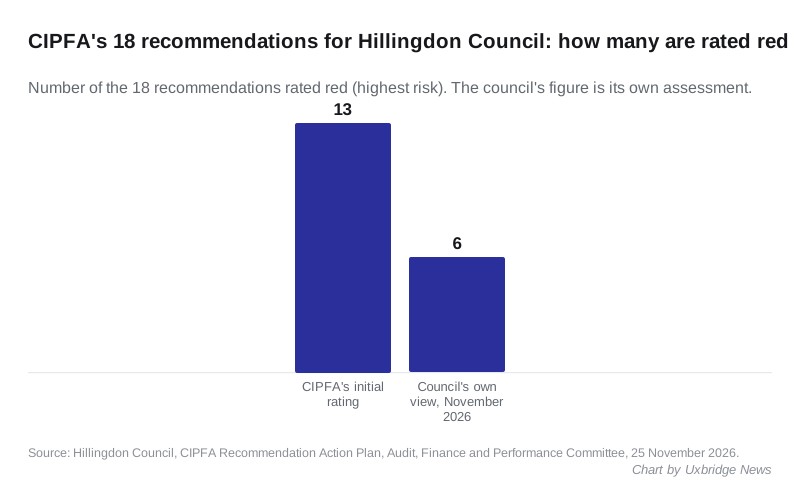
CIPFA rated 13 of its 18 recommendations red. In the council’s own view, six are still red, eleven amber and one green. That is the council marking its own progress; CIPFA’s report was based on information from February and March.
The six the council still rates red include:
- exploring all savings options with Cabinet, including politically difficult ones
- a strategic policy for selling council land and buildings
- reviewing the capital programme to defer or drop schemes
- a high-level corporate plan within a balanced budget
What it costs
The government-set fee for the council’s 2025/26 audit is £445,816, up from £433,673 the year before. The pension fund audit costs £96,295. A one-off £30,357 is added on top for the national scheme to clear the local audit backlog.
What it means for you
- Council tax payers fund the audit and the extra work to rebuild assurance. The fee is set nationally, not by the council.
- The committee meeting is public. It starts at 6pm on Wednesday 25 November in Committee Room 5 at the Civic Centre. The papers are on the council’s meeting page.
- EY’s full draft annual report and audit results report are marked “to follow” in the papers. We will report what they say when they are published.
A separate peer review of the council, which Cabinet takes on 19 November, points to a forecast budget gap of £43.5m in 2028/29.
Have your say