
Hillingdon says the draft Heathrow rules give no route to a no, and a £3,000 noise insulation cap is under half Gatwick's £6,500. What it wants changed.
Hillingdon Council has told the government that its draft rules for a third runway at Heathrow offer “no obvious route to a decision of ‘no’”. The council’s 95-page response to the draft Heathrow Expansion National Policy Statement is published with the papers for Cabinet on Thursday 17 September.
The council says it “remains unequivocally opposed to expansion”. But it also accepts the decision will be taken by the government and Parliament. So most of the document sets out what it wants changed if a third runway goes ahead.
The government published the draft policy on 18 June 2026. Consultation closed on 1 September. The Cabinet report says the final version is expected to be laid before Parliament in November 2026.
What the policy statement does
The National Policy Statement would replace the Airports National Policy Statement. It sets the tests any third runway application must pass. The application itself would then go through a Development Consent Order, the planning route for nationally significant infrastructure.
Under the Planning Act 2008, that decision is taken by the government, not by Hillingdon. The council’s report says this is why it is trying to shape the rules as well as opposing them.
The four tests “contain no meaningful red lines”
The draft sets four principal tests: economic growth, air quality, noise and climate change. The council says none of them has pass or fail criteria.
In the foreword to its response, it says the framework “appears designed to make expansion possible rather than determine whether it is acceptable.”
The changes the council is asking for include:
- clear pass and fail criteria for every test
- a fifth test, a Community Impact Test, with the same weight as the other four
- enforceable mitigation, with independent monitoring rather than Heathrow reporting on itself
- a permanent community compensation fund paid for by the airport operator
- property compensation rules set by the government, not by the developer
- a framework for handling the two competing expansion proposals
The proposed Community Impact Test would make the airport show measurable results on local jobs and apprenticeships, local suppliers, health, deprivation, community facilities and access to services. The council wants communities left “better off”, not “no worse off if possible”.
The noise offer
The sharpest numbers in the response are about noise insulation.
The draft offers a contribution of up to £3,000 per home for acoustic insulation inside set noise contours. The council points out that Gatwick offered up to £6,500, “despite affecting far fewer properties”. It says the Heathrow figure “appears to have been determined by what is affordable to the Airport Operator rather than what is necessary to protect residents”.
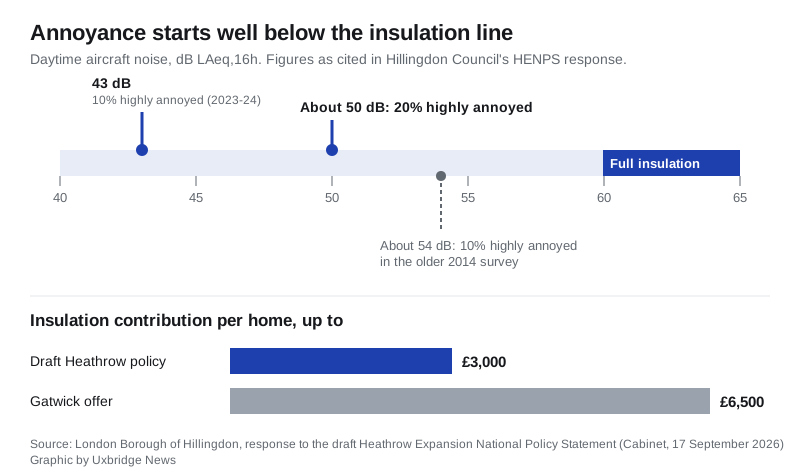
Full insulation would still start at a daytime average of 60 decibels. The council says the government’s own newer evidence has moved on:
- the Aviation Noise Attitudes Survey 2023-24 found about 10% of people highly annoyed at 43 dB
- the earlier 2014 survey put that same 10% level at about 54 dB
- about 20% are highly annoyed at around 50 dB
The council’s conclusion is that a large group of residents would be counted as highly annoyed by the government’s own survey and still get “no insulation, no compensation and no other meaningful mitigation”. It also asks why a home at 59 dB gets nothing when one at 60 dB qualifies.
The economic case
The council quotes the government’s own Heathrow Expansion Appraisal Report. According to the council’s reading of it:
- monetised benefits are put at £29.2 billion to £42.4 billion
- once environmental costs, construction costs and the effect on airport and airline profits are included, the net present value is negative in all core scenarios
- the wider economic modelling finds a gain of about 0.05% of GDP by 2056
- an independent peer review found about 88% of that GDP gain comes from construction spending, not from better connections
The council says this “falls well short of demonstrating a compelling economic case for expansion”.
Harmondsworth and Sipson
The response says the current proposals would leave Harmondsworth and Sipson, about four miles south of Uxbridge, “at best heavily blighted and, at worst, potentially unviable in their current form”. It also expects “millions of square feet” of logistics and commercial space to be displaced, and “two of the largest car parks in Europe” to be built.
On property, the council warns about the Wider Property Offer Zone. The consultation material, it says, gives “the clear impression” that homes in the Heathrow Villages would benefit. But the eligibility rules have not been written, and earlier Heathrow proposals gave the airport “considerable discretion” over who qualified. The council says many properties south of the M4 could be shown inside the zone and then excluded.
It also rejects the draft’s suggestion that extra business rates could fund community benefits. It says hotels, commercial premises and major employers would be lost to the scheme first, cutting business rates during construction.
Why the council is engaging at all
The Cabinet report is open about the risk. Its risk table lists being “seen to weaken opposition of Heathrow Expansion”. Its answer is that the response is “heavily caveated”, and that there is “a greater risk to communities should the Council simply maintain opposition and not engage”.
Cabinet is asked to note the response and to let officers keep lobbying the Department for Transport after the consultation. The report says the response has already been submitted. Council Leader Cllr Tuckwell is the Cabinet Member lead.
What it means for you
- The public consultation has closed. It ended on 1 September, so the council’s response is now the borough’s main route into the final text.
- The next date is November 2026, when the final policy statement is expected to go before Parliament.
- If you live in the Heathrow Villages, the council’s warning is that the property offer rules are not settled. Nothing in the draft yet tells you whether your home qualifies.
- Noise insulation is not settled either. The £3,000 figure and the 60 dB threshold are in the draft, and the council is asking for both to change.
The meeting is at 7pm in Committee Room 6 at the Civic Centre, Uxbridge, according to the Cabinet agenda. Wider planning stories in the borough are on our Uxbridge planning news page.
Sources
- Hillingdon Council: Cabinet report, Consultation Response to the Heathrow Expansion National Policy Statement, 17 September 2026
- Hillingdon Council: response to the draft Heathrow Expansion National Policy Statement (95 pages)
- Hillingdon Council: Cabinet agenda, 17 September 2026
- GOV.UK: Heathrow Airport expansion collection, draft HENPS documents published 18 June 2026
Have your say