
Drive over the pavement to your drive without a dropped kerb and Hillingdon may bollard it off after two warnings and 21 days. What a legal one costs.
Hillingdon Council will start putting bollards or barriers on pavements and verges from November to stop drivers crossing them to reach their homes without a dropped kerb.
The council announced the approach on 27 October. It applies to property owners who “persistently ignore warnings”, it said. (Hillingdon Council)
How it will work
The council has set out three steps:
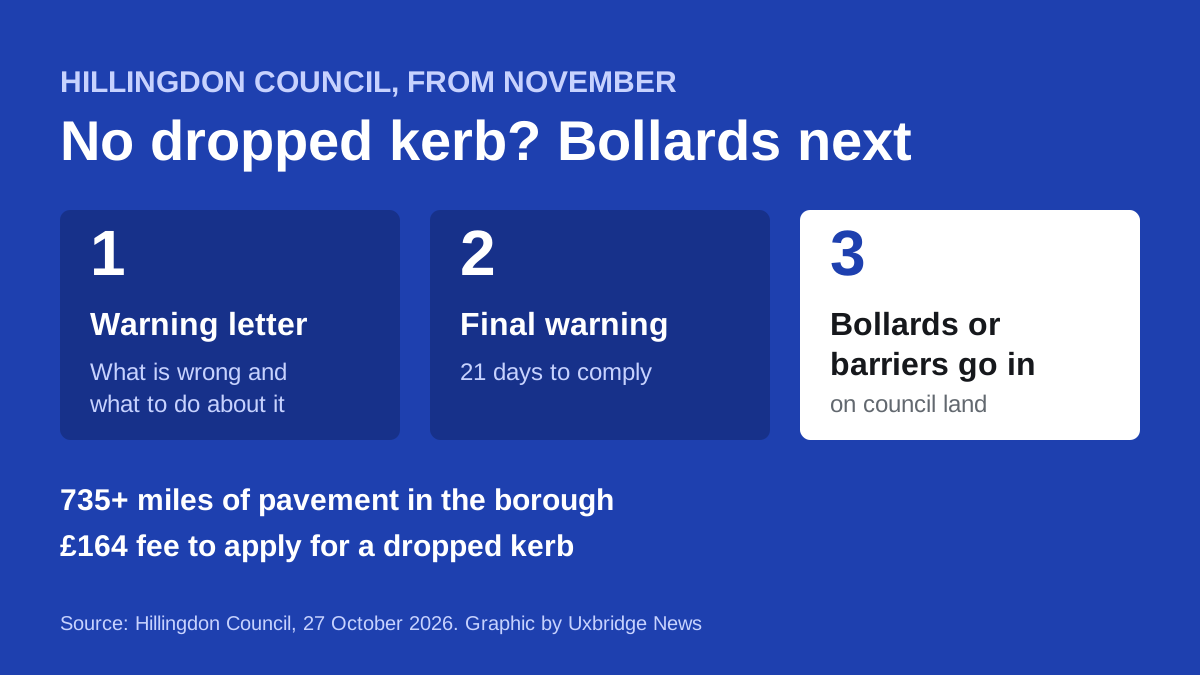
- A first warning letter, explaining the breach, what needs to be done and what happens if nothing changes.
- A final warning if the problem carries on, with 21 days to comply.
- Bollards or barriers installed on the council’s highway, under the Highways Act 1980 and the Traffic Management Act 2004, to stop vehicles crossing at that spot.
The council says driving over a pavement or grass verge without an authorised vehicle crossover is illegal. It says it damages the surface and can break pipes and cables underneath. A properly built crossover, or dropped kerb, has a strengthened pavement that can take a car’s weight.
Councillor Wayne Bridges, the Cabinet member for residents services, said the borough has more than 735 miles of pavements. The council would “use the legal powers available to us to take tougher action to protect our highways against those few who repeatedly ignore the rules”, he said. “I encourage residents to take action promptly if they receive a warning.”
The council has not said how many homes it has warned so far, or how many it expects to bollard.
What a legal dropped kerb involves
Only the council can build a dropped kerb in Hillingdon, and the householder pays for all of it. The council’s guidance sets out the process. (Hillingdon Council: applying for a dropped kerb)
| Step | What the council says |
|---|---|
| Application fee | £164 for residents, £180 for non-residents, not refunded if refused |
| Decision | Within 10 to 15 working days |
| Building cost | Varies by size and obstructions; an officer visits and sends an estimate, valid 90 days |
| Construction | Aimed for within 8 weeks of payment |
| Classified roads | Planning permission needed as well |
Not every frontage qualifies. The guidance says a hardstanding should normally be 4.8 metres deep, so a parked car does not overhang the pavement. A smaller car can be approved on a frontage at least 3.8 metres deep. A single crossover must be at least 2.4 metres wide. (Hillingdon Council: guidance notes)
Applications can also be refused if digging would harm the roots of a street tree, or in areas at risk of flooding, where grass verges help water drain away. A refusal can be appealed in two stages, but not simply because neighbours have older crossovers. (Hillingdon Council: application process)
What it means for you
If you park on your front garden and reach it over a kerb that has not been dropped, a letter from the council is now the first warning of three. You have 21 days from the final warning before bollards can go in.
The guidance has one more line worth knowing. Anyone who does get a dropped kerb must put up a wall, fence or permanent planting along the rest of the frontage, so cars cannot cross the unstrengthened pavement beside it.
Parking costs in the borough are rising too: see our report on the 2027 car park charges and our Uxbridge parking guide.
Sources
- Council crackdown on unauthorised driveway access, Hillingdon Council, 27 October 2026
- Applying for a dropped kerb, application process and guidance notes, Hillingdon Council, checked 29 October 2026
Have your say