

Hillingdon decides by 7 September whether parking and storage off Harefield Road is already lawful. The petition against it closes 3 September.
Hillingdon Council has until Monday 7 September to decide whether parking and storage on land off Harefield Road in Uxbridge is already lawful. Twenty-eight residents have signed a petition asking it to refuse. Their petition closes four days before that deadline, on 3 September.
The application is not for planning permission. It asks the council to certify that a use already happening on the land cannot be stopped. That difference decides everything about what happens next, and it is the part the petition wording does not spell out.
What the register actually records
The council’s planning register lists the application as follows. (Application 80177/APP/2026/1748, Hillingdon Council planning register)
- Reference: 80177/APP/2026/1748
- Site: land lying to the north west of Harefield Road, Uxbridge, UB8 1PW
- Proposal: use of land for parking and storage, as an application for a Certificate of Lawful Development for an Existing Use
- Ward: Uxbridge
- Received and validated: 13 July 2026
- Decision due by: 7 September 2026
- Status: undecided
The register lists no other application under the same site reference. It also records no neighbour consultation start date and no comment deadline for this application.
Why a certificate is not a planning decision
A certificate of lawfulness is a ruling on fact and law, not on whether something is a good idea. Section 191 of the Town and Country Planning Act 1990 sets the test. A use is lawful if no enforcement action may then be taken against it. (Town and Country Planning Act 1990, section 191)
Enforcement runs out with time. For a change of use of land in England, the council has ten years from the date of the breach. After that, no enforcement action may be taken. (Town and Country Planning Act 1990, section 171B)
So the question in front of the case officer is narrow. Has this use run long enough, and consistently enough, that the council could no longer act against it?
The government’s guidance is blunt about the rest. “Planning merits are not relevant at any stage in this particular application or appeal process.” The burden sits with the applicant, and the standard is the balance of probability. Where the council holds no evidence of its own to contradict a precise and unambiguous account, the guidance says there is no good reason to refuse. (Lawful development certificates, Planning Practice Guidance)
And section 191 leaves the council no discretion at the end of it. If the evidence satisfies the authority, “they shall issue a certificate to that effect”.
What the petition says
The petition is titled “Land adj Fray’s Farm, 80177/APP/2026/1748” and opened on 24 August. It runs to 3 September, a shorter window than the usual month. It had 28 signatures when we read the register on 27 August. (ePetition 518, Hillingdon Council)
The petitioners oppose a certificate for use of the site as, in their words, “an Industrial Vehicle Park and storage area”. Their stated grounds are:
- access runs along a track and footpath beside the River Frays and the nature reserve
- they describe the site as green belt
- heavy vehicles create “noise, vibration, and environmental pollution”
- they say the present uses “may be a breach of Planning control”
That last point is the one that matters legally, and it cuts both ways. A breach of planning control is exactly what a certificate of lawfulness is for, once enough time has passed.
Natural England’s Local Nature Reserves dataset records Frays Valley Local Nature Reserve, 71.9 hectares, in this stretch of the valley. Measured from the UB8 1PW postcode point, its boundary is about 500 metres away. (Local Nature Reserves (England), Natural England open data)
We have not been able to verify the green belt boundary at the application site itself, and the council’s decision on a certificate does not turn on it either way.
The catch the petition page half-admits
Hillingdon’s own rules exclude this application type from its planning petition scheme. The council’s page on petitions about planning applications lists the types that cannot be petitioned, and “certificates of lawfulness” is on it, alongside prior approval applications, tree works and discharge of conditions. (Petitions about planning applications, Hillingdon Council)
The council spells out the consequence. A petition on one of those types “will be placed on the planning file and considered by planning officers where relevant, but it will not be treated as a planning petition enabling speaking rights at a Planning Committee”.
The petition page itself carries a version of this warning, which is more than the register usually offers. It tells signatories the application “is excluded from the definition of ‘planning applications’” and so will not go before a committee, but that the petition will be passed to the case officer.
Two other things follow from that:
- there is no committee meeting, so nobody gets to speak
- the decision rests with the case officer, against the statutory test, not against the strength of local feeling
Hillingdon’s planning petition threshold is 20 signatures until 31 October 2026, when it rises to 50 under national planning reforms. This petition has already passed the current threshold.
What it means for you
If you live near the site and want to affect this decision, the useful thing to send is evidence, not objection.
Because the test is factual, only material that bears on the facts can weigh. That means dated photographs, records or first-hand accounts of what the land has been used for and when, particularly anything showing the use started later than the applicant claims, or stopped and restarted. Objections about noise, traffic or wildlife cannot be taken into account on this application, however strongly felt.
If the certificate is refused and the use carries on, the route is enforcement rather than planning. The council asks for the exact address, when activities started, and the nature of the use. It also warns that formal action cannot be taken where the works or change of use do not need permission. (Report a planning breach, Hillingdon Council)
If the certificate is granted, the use becomes lawful for planning purposes and the council cannot enforce against it.
The dates that matter
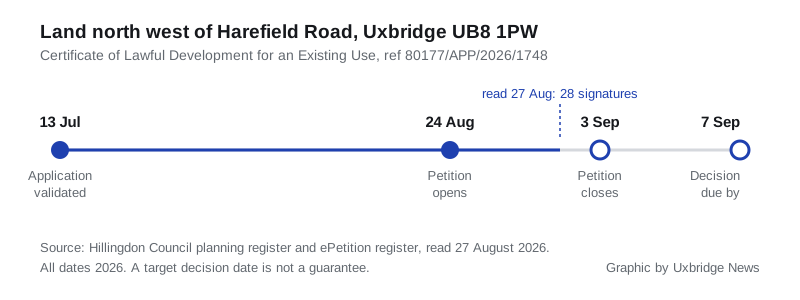
- 13 July 2026: application received and validated
- 24 August 2026: petition opens
- 3 September 2026: petition closes
- 7 September 2026: council’s target date for a decision
A target date is not a guarantee. Applications frequently run past them, and the register will show the outcome when it is issued.
We track this and other cases on our Uxbridge planning news page.
Have your say